What is a Marketing Funnel?
- The basic idea behind a marketing funnel
- Awareness: getting on the radar
- Interest: turning attention into engagement
- Desire: helping people want your offer
- Action: making the decision easy
- The funnel does not end at the sale
- How to build a funnel that actually works
- How to measure each stage without getting lost in data
- B2B and B2C funnels are similar, but they don’t behave the same way
- Marketing funnel vs. sales funnel
- A funnel is never finished
If you run a small business, you’ve probably felt this frustration: people see your posts, maybe even click your website, and then nothing happens. No call. No purchase. No form submission. Just silence.
That’s usually not a traffic problem. It’s a funnel problem.
A marketing funnel is a simple way to understand how people move from first hearing about your business to actually buying from you. It gives structure to something that can otherwise feel messy and random. And honestly, for small teams with limited time, that structure matters a lot.
The classic version of the funnel follows AIDA: Awareness, Interest, Desire, and Action. People discover you, start paying attention, begin to want what you offer, and then decide whether to buy. The funnel shape exists because some people naturally drop off at every step. That’s normal. The goal isn’t to keep everyone. The goal is to guide the right people forward with the right message at the right time.
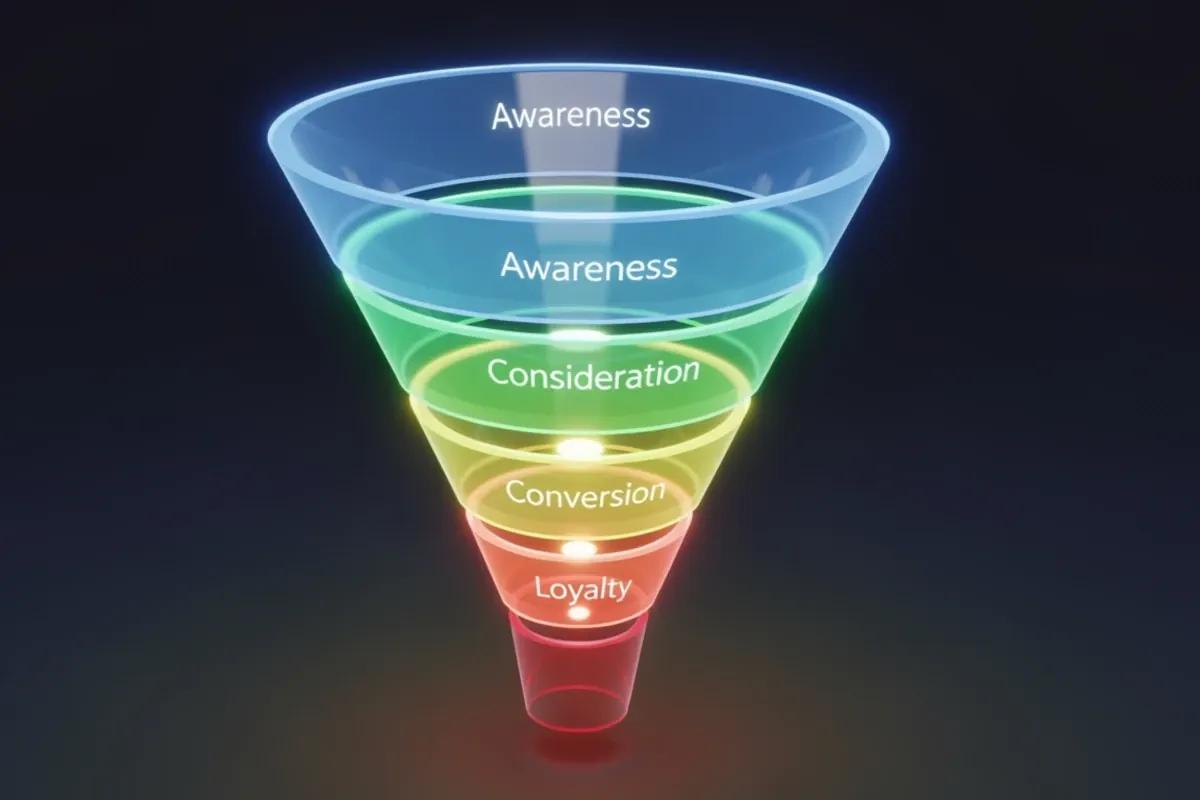
The basic idea behind a marketing funnel
Think of the funnel as a map of customer intent.
At the top, people are just becoming aware that your business exists. They may not know much about you, and they may not even know they need your solution yet. In the middle, they’re paying closer attention. They’re reading, comparing, watching, and asking questions. Near the bottom, they’re weighing whether to trust you enough to move forward. Then comes the moment that matters most for revenue: action.
A lot of business owners skip this logic and go straight to “Buy now.” I get why. Sales are urgent. But most people do not buy the first time they see a brand, especially if the product or service takes any thought at all. If your marketing only talks to people who are already ready to buy, you miss everyone else.
That’s why funnels matter. They help you match your content and offers to the customer’s mindset instead of shouting the same message at everyone.
Awareness: getting on the radar
Awareness is the top of the funnel, often called TOFU. This is where people first come across your business through social media, blog posts, search engines, local listings, video ads, or word of mouth.
The job here is not to close the sale. It’s to earn attention.
That means your content has to meet people where they are. A local service company might publish blog posts that answer common questions, create short videos that explain a problem, or run targeted ads based on location and interest. A retailer might focus on search visibility and social content that is easy to share. In both cases, the point is the same: show up in relevant places and make a strong first impression.
This stage is where content creation pulls a lot of weight. Good top-of-funnel content teaches, solves a small problem, or makes something clearer. It doesn’t need to be fancy. It does need to be useful. If someone finds your page through a search query and immediately feels like you understand their problem, that is a very good start.
The metrics that usually matter here are reach, impressions, organic traffic, and new users. If no one sees your business, nothing else in the funnel can work.
Interest: turning attention into engagement
Interest is the middle of the funnel, or MOFU. This is where people move from “I’ve heard of you” to “I want to know more.”
You’ll see this stage when someone follows your page, spends time on your site, signs up for your email list, reads more than one article, or comes back for a second visit. They haven’t committed yet, but they’re no longer casual browsers either.
Your job at this stage is to build trust and keep the conversation going.
Educational content works well here because it reduces uncertainty. Case studies, FAQs, beginner guides, explainer videos, and email sequences can all help. Reviews matter too. So does clarity. If a prospect has to work hard to understand what you do, what it costs, or who it’s for, interest tends to fade fast.
This is also where small businesses can benefit from thoughtful personalization. If someone downloaded a guide about a specific service, the follow-up email should probably talk about that service, not your entire company history. People respond when the next step feels relevant.
In practical terms, the metrics for interest include engagement rates, time on site, email sign-ups, return visits, and content interactions. If your awareness numbers look healthy but no one sticks around, your message may be attracting the wrong audience, or your content may not be helping them move forward.
Desire: helping people want your offer
Desire lives near the bottom of the funnel. At this point, the prospect understands the problem, knows your business exists, and is actively comparing options.
This stage can feel uncomfortable because it forces honesty. People are asking themselves hard questions. Why choose you instead of a competitor? Is your offer worth the price? Will this solve the problem well enough to justify the effort? What might go wrong?
Your marketing has to answer those questions clearly.
This is where your differentiators matter, but vague claims are useless. “Great service” means almost nothing because everyone says that. More persuasive details might include faster turnaround times, simpler onboarding, a specific guarantee, clear pricing, stronger reviews, or proof that you’ve solved similar problems before.
Comparison pages, detailed service pages, testimonials, demos, consultations, and objection-handling content all belong here. Social proof becomes especially powerful because people trust evidence more than slogans. If a prospect is hesitating, they often need reassurance, not more hype.
Useful metrics at the desire stage include product or service page views, comparison page visits, demo requests, consultation bookings, and lead qualification data. If people show interest but never make it to a buying conversation, the problem may be weak positioning or unresolved objections.
Action: making the decision easy
Action is the purchase stage. This is where someone decides to buy, book, subscribe, or contact you.
At this point, friction is dangerous.
Even interested buyers can disappear if the checkout process is clunky, your call to action is confusing, or your forms ask for too much information. One of the most common small business mistakes is assuming that motivation alone will carry people through. It won’t. People are busy, distracted, and sometimes a little suspicious. If taking the next step feels annoying, they put it off.
A strong action stage is simple. The call to action is visible and specific. The path to purchase is short. Pricing is easy to understand. Mobile users are not punished. Guarantees, deadlines, and limited-time offers can help, but they only work if the trust is already there.
This stage is where conversion rate, purchases, average order value, and cart abandonment rate matter most. If people are reaching the bottom of the funnel but not converting, the issue may have less to do with your ad copy and more to do with your buying experience.
The funnel does not end at the sale
One of the biggest mistakes in funnel thinking is treating the purchase as the finish line. It isn’t. For many businesses, the real value comes after the first sale.
Loyalty and advocacy are the stages that often get ignored, which is strange because they are usually cheaper than constant customer acquisition. A happy customer is easier to sell to again than a stranger is to convince for the first time. A loyal customer may also leave reviews, refer friends, and share your business with almost no prompting if the experience was genuinely good.
Post-purchase marketing should feel helpful, not needy. Follow-up emails, onboarding guides, check-ins, easy support, loyalty programs, and referral incentives can all play a role. Encouraging reviews is especially smart for local and service-based businesses because trust compounds. One good experience can influence several future buyers.
The numbers to watch here include retention rate, repeat purchase rate, referral rate, and Net Promoter Score. If customers buy once and vanish, that tells you something important about the experience after the sale.
How to build a funnel that actually works
A useful funnel starts with observation, not assumptions.
Begin by mapping the customer journey you already have. How do people usually find you? What pages do they visit? Where do they hesitate? When do they leave? If you can see the drop-off points, you can start fixing them.
For example, if traffic is strong but email sign-ups are weak, the issue may be your offer at the interest stage. If consultations are high but closed deals are low, the problem may sit in the desire stage. If shoppers add to cart but do not complete payment, the action stage needs attention.
Once you know where the leak is, match your strategy to that stage. A funnel rarely improves because you “do more marketing” in a general sense. It improves when you solve a specific problem. That might mean better SEO content at the top, stronger email nurturing in the middle, clearer proof near the bottom, or a simpler checkout at the end.
This is also where AI marketing can be genuinely useful. I’m cautious about overpromising here because AI is not a substitute for judgment. Still, it can save a lot of time. It can help draft blog posts, test subject lines, segment audiences, personalize email sequences, summarize customer feedback, and speed up routine content creation. For small teams, that efficiency matters.
Some of the best small business tools now combine automation with analytics, which makes it easier to see how content performs at each stage. And whether a platform calls its assistant a Smart Editor or a Craft Buddy, the real value is the same: faster drafting, cleaner workflows, and more time for the decisions only humans should make.
How to measure each stage without getting lost in data
Metrics are useful only if they help you decide what to do next.
At the awareness stage, pay attention to reach, impressions, organic traffic, and new visitors. These tell you whether people are finding you at all. If the numbers are low, you may need better SEO, stronger targeting, or more consistent publishing.
At the interest stage, look at time on site, engagement rates, email subscriptions, and repeat visits. These show whether your audience cares enough to stay involved. Weak performance here often means your content attracted curiosity but failed to build confidence.
At the desire stage, measure behaviors that signal evaluation, such as service page visits, pricing page views, demo requests, or quote requests. If prospects are circling but not committing, your messaging may not be resolving the questions that matter most.
At the action stage, conversion rate is the obvious one, but don’t stop there. Cart abandonment, form completion rate, and average order value reveal friction and buying patterns. A decent conversion rate with a lot of abandoned carts usually means something in the process feels off.
After purchase, track repeat purchase rate, retention, referrals, and customer satisfaction. If customers come back and bring other people with them, your funnel is not just acquiring buyers. It is building momentum.
The broader point is simple: tie metrics to stages. Otherwise, you end up drowning in dashboards without understanding what’s broken.
B2B and B2C funnels are similar, but they don’t behave the same way
The core stages of a marketing funnel stay fairly consistent whether you sell to businesses or individual consumers. People still move through awareness, interest, desire, and action. What changes is the pace and the type of proof they need.
B2C funnels are often shorter. People may make faster decisions, especially for low-cost products or familiar services. Emotion, convenience, timing, and social proof can have a strong effect. A good offer with low friction can convert quickly.
B2B funnels usually take longer. There may be multiple decision-makers, higher prices, approval steps, and more research. Buyers often want detailed information, demos, case studies, and evidence of return on investment. Nurturing matters more because trust has to hold up across a longer timeline.
Small business owners sometimes borrow funnel tactics from giant e-commerce brands or enterprise software companies and then wonder why the results feel strange. The stage model still works, but the content and timing must fit your audience.
Marketing funnel vs. sales funnel
People often use these terms like they mean the same thing. They don’t, though they overlap.
The marketing funnel is about attracting attention and nurturing interest. It gets people from stranger to qualified lead. The sales funnel picks up when direct conversion activity starts, such as consultations, proposals, demos, negotiations, and closing.
For a very small business, those two funnels may blur together because the same person is doing both jobs. That’s normal. Still, it helps to separate them mentally. If marketing brings in the wrong leads, sales struggles. If sales messaging clashes with what marketing promised, trust breaks.
The best results come when both sides support the same journey. Marketing should prepare people for the sales conversation. Sales should reinforce, not contradict, the expectations created earlier.
A funnel is never finished
This is the part many people resist because it sounds ongoing, and it is. A marketing funnel is not a one-time setup. It is a model you test, revise, and improve.
Messages get stale. Channels shift. Customer behavior changes. A page that worked last year may quietly stop working. That’s why steady experimentation matters. Try new headlines. Test different offers. Rewrite weak calls to action. Adjust your email timing. Simplify a form. Improve a follow-up sequence. Then measure what changed.
The good news is that small improvements at each stage can compound. A little more qualified traffic, a little better engagement, a little less friction at checkout, a little stronger retention. That adds up.
A solid funnel does not make marketing effortless. I wish it did. What it does is make your effort more deliberate. Instead of guessing why results are inconsistent, you start seeing where people drop off, what they need next, and how to help them move forward.
That clarity is worth a lot.

