How to Master Top-of-Funnel Marketing
- What top-of-funnel marketing actually does
- The funnel, without the fluff
- What exceptional TOFU content has in common
- The content formats that work best at the top of the funnel
- Blogs
- Social media posts
- Videos
- Webinars and live events
- Podcasts
- Infographics
- Demos
- Case studies
- How to pick TOFU topics that attract the right people
- How AI fits into top-of-funnel marketing
- The gentle handoff from TOFU to the next stage
- What to measure at the top of the funnel
- Common TOFU mistakes that quietly weaken results
- The real goal of top-of-funnel marketing
If your marketing often feels like talking to people who are not ready to buy yet, that is not a failure. That is the job.
Top-of-funnel marketing, usually shortened to TOFU, is the first stage of the buyer journey. It is where people first discover your business, first notice a problem clearly enough to care about it, or first start looking for ways to solve it. At this stage, hard selling usually backfires. People are not asking for a pitch. They are asking for clarity.
That is why good TOFU marketing feels helpful instead of pushy. It teaches. It answers basic questions. It frames a problem in a way that makes sense. Done well, it creates awareness and trust long before a sales conversation starts.
For small business owners, this part matters more than it used to. Buyers now research on their own, compare options quietly, and spend a lot of time learning before they ever fill out a form. If your business only shows up when someone is ready to purchase, you are arriving late. Top-of-funnel content helps you show up earlier, when attention is still open and habits are not set.
What top-of-funnel marketing actually does
A lot of people hear “awareness” and think it means vague branding. It does not have to. Good TOFU marketing has a practical job. It introduces your business to the right audience and gives them a reason to remember you.
At the top of the funnel, your goal is not to close the deal in one shot. Your goal is to be useful enough that a stranger becomes a known visitor, a subscriber, a follower, or a lead. That first touch shapes what happens later. If the first impression is helpful and credible, the next step feels natural. If it feels like a sales ambush, most people leave.
This is especially true in B2B and service-based buying, where decisions often involve research, comparison, and internal discussion. People want to understand the problem first. They want context. They want to know what good looks like before they think about vendors. TOFU content earns attention by meeting that need.
The funnel, without the fluff
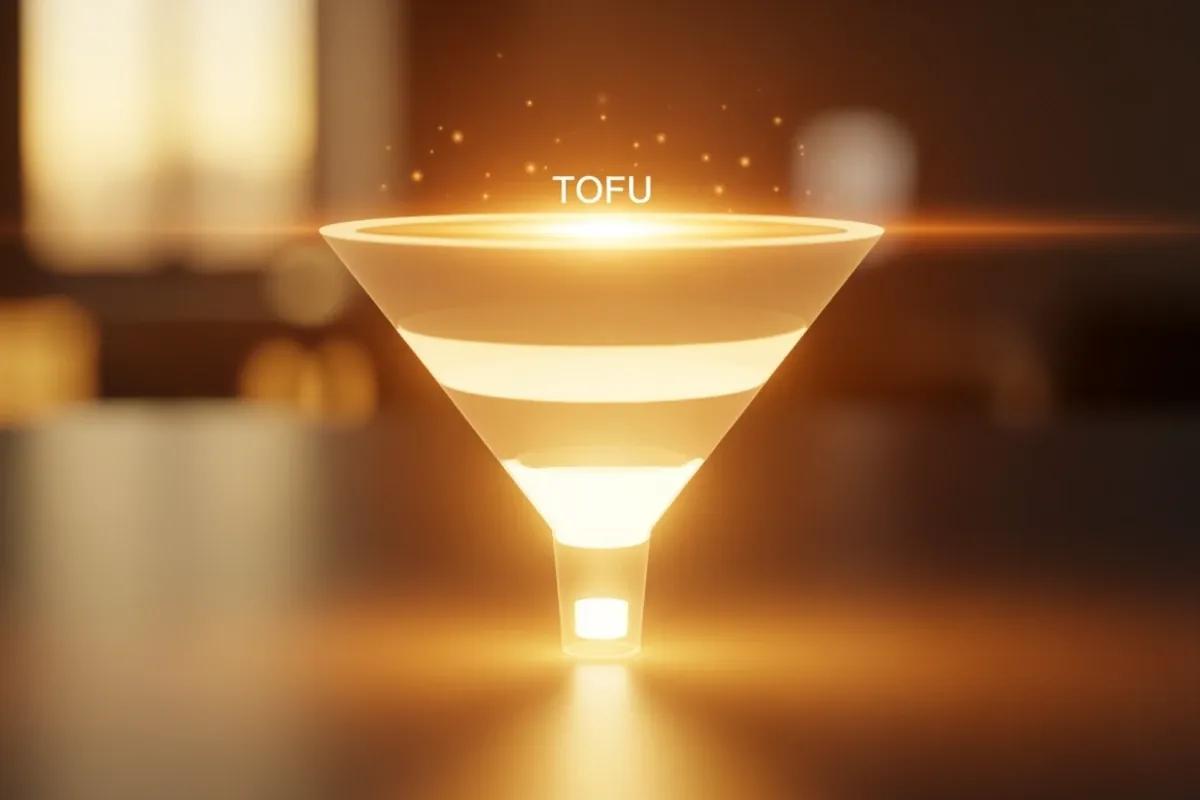
The sales funnel is just a way to describe buyer readiness.
At the top, people are in the awareness stage. They may not know much about your company, and some may not even fully understand their own problem yet. This is where educational content works best.
In the middle of the funnel, people are in consideration mode. They know the problem is real and are comparing approaches, tools, or providers. They want more detail, more proof, and more substance.
At the bottom, they are close to making a decision. This is where conversion-focused content matters most. Pricing pages, consultations, product comparisons, demos, and offers carry more weight here.
A common mistake is treating all three stages the same. A top-of-funnel reader does not usually want a direct sales pitch. A bottom-of-funnel buyer does not want another broad educational article. Matching the content to the stage sounds obvious, but plenty of marketing misses this and wonders why engagement is weak.
What exceptional TOFU content has in common
The best TOFU content tends to share a few traits, even when the format changes.
First, it speaks to a broad but relevant audience. Broad does not mean generic. It means the content addresses a common problem many ideal buyers face early in their journey. For example, “How to Improve Local Search Visibility” is broad enough to attract interest. “Why Our Premium Plan Solves Multi-Location Schema Conflicts” is far too narrow for most awareness-stage readers.
Second, it teaches without hovering over the reader’s shoulder waiting to sell. This is where many businesses get twitchy. They worry that if they give away useful information, people will not buy. In reality, the opposite is often true. Helpful content builds trust. Thinly disguised sales copy drains it fast.
Third, strong TOFU content makes your business easier to discover. Search-friendly blog posts, shareable visuals, short videos, and thoughtful social posts can attract people long before they know your name. That discoverability matters because awareness content often compounds. One useful article can keep bringing in traffic months after publication.
Fourth, it creates assets you can reuse later. A blog post can become a webinar topic. A webinar can become clips, quotes, a summary article, and an email series. A customer story can support both awareness and later-stage decision-making. Good TOFU work does not live once and disappear.
The content formats that work best at the top of the funnel
Different people learn in different ways, so relying on one format usually leaves reach on the table. A healthy TOFU strategy uses a mix.
Blogs
Blogs are still one of the most reliable TOFU tools because they answer questions people are already searching for. They help with SEO, they are easy to update, and they can keep attracting traffic over time. For small businesses, this matters a lot. A single well-written article can do more steady work than a week of rushed posting.
The best awareness-stage blog topics are practical and problem-led. Think less about what you want to say and more about what your audience keeps wondering about.
Social media posts
Social posts move faster and reach wider, even if the attention is shorter. They are useful for introducing ideas, reacting to common pain points, and driving people toward longer content. They also help you test language. If a topic gets strong engagement in a short post, it may deserve a full article or video.
What works here is clarity. One sharp insight usually beats a wall of text.
Videos
Video is strong at the top of the funnel because it can explain ideas quickly and show personality at the same time. Some people would rather watch a two-minute explanation than read 1,500 words. Fair enough. Video can simplify complex topics, build familiarity, and make your expertise feel more human.
You do not need a studio setup. Clear thinking matters more than cinematic lighting.
Webinars and live events
Webinars give you something rare in TOFU marketing: real-time attention. People can ask questions, hear examples, and spend more time with your ideas than they usually would on a social platform. That extra time often translates into better trust and stronger lead capture.
Live sessions also reveal what your audience is confused about. The questions people ask are content ideas in plain sight.
Podcasts
Podcasts work well when your audience likes to learn while commuting, working, or walking the dog. They are slower-burn than social content, but they can build strong familiarity over time. Hearing someone explain a topic in depth creates a different kind of connection than scanning a short post.
For authority and thought leadership, podcasts are underrated. They let nuance breathe.
Infographics
Some topics are easier to grasp visually. Infographics can distill a process, a comparison, or a set of trends into something quick and shareable. They are useful when your audience is overwhelmed by dense information and needs a clean entry point.
That said, bad infographics are everywhere. If the design is pretty but the message is muddy, people move on.
Demos
A demo usually sounds like bottom-of-funnel content, but light, educational demos can work earlier too. If your offering solves a problem people are just starting to understand, a simple demonstration can make the issue feel concrete. The key is tone. At TOFU, the point is to illustrate value, not corner someone into a buying decision.
Case studies
Case studies are often treated as decision-stage proof only, but they can help earlier if framed well. At the awareness stage, a case study should tell a problem story first. What was happening? Why did it matter? What changed? Readers do not need a heavy sales pitch. They need evidence that real results are possible.
How to pick TOFU topics that attract the right people
This is where many content plans go sideways. Businesses pick topics they find interesting, then wonder why the audience does not care.
Start with real questions. What do prospects ask before they are ready to buy? What misconceptions slow them down? What early problems send them searching? Those are your TOFU topics.
For a small business, this usually means stepping back from product language and returning to customer language. Your audience is probably not searching for your internal terminology. They are searching for practical help. “Why are my leads inconsistent?” is a better starting point than “overview of our lead management framework.”
This is also where audience mapping matters. Different buyer personas ask different first-stage questions. A founder may care about cost and efficiency. A marketer may care about output and workflow. An operations lead may care about speed and consistency. One topic can sometimes serve all three, but not always.
The more closely your content matches those early decision-making questions, the stronger your TOFU performance tends to be.
How AI fits into top-of-funnel marketing
AI marketing tools have changed the pace of content creation, especially for small teams. That is the good news. The catch is that speed alone is not a strategy.
Used well, AI can help you research topic clusters, summarize customer questions, draft article outlines, turn webinar transcripts into blog posts, and personalize follow-up content. For small business owners who are juggling ten other jobs, that kind of efficiency is hard to ignore. It can make a consistent publishing rhythm possible where none existed before.
Used badly, AI fills the internet with bland, interchangeable content that says very little. You have probably read some of it. It sounds polished at first and empty by paragraph three.
The fix is simple, though not always easy. Use AI to reduce repetitive work, not to outsource judgment. Let it help with structure, speed, and repurposing. Keep the strategic part human. Your audience still wants a real point of view, real examples, and content that sounds like someone actually understands the problem.
This is where smart content creation habits matter more than shiny tools. If AI helps you publish faster but your topics are weak or your message is salesy, you just scale mediocrity. If your topics are strong and your insight is real, AI can make a lean team feel much bigger. That is the version worth chasing.
The gentle handoff from TOFU to the next stage
Top-of-funnel content should not sell hard, but it should still lead somewhere.
After someone reads an article, watches a video, or attends a webinar, the next step should feel easy and logical. Maybe that is joining your newsletter for more practical tips. Maybe it is downloading a guide, signing up for a future webinar, or reading a more detailed comparison article. The point is to create movement without pressure.
This is where many awareness campaigns leave value on the table. They attract attention, then offer no clear path forward. A reader learns something useful and disappears. That is a missed opportunity.
A good TOFU asset gives value first, then offers a simple next action that matches the buyer’s level of readiness. The handoff should feel like, “If this helped, here is the next useful thing,” not, “You glanced at our article, now book a sales call immediately.”
What to measure at the top of the funnel
TOFU success is not measured the same way as bottom-of-funnel success, and forcing those numbers too early can lead to bad decisions.
At this stage, reach and engagement matter. You want to know whether people are finding the content and whether it holds their attention. Views, impressions, clicks, time on page, video watch time, shares, saves, and traffic sources can all tell you something useful. So can newsletter signups, webinar registrations, and returning visitors.
These metrics are not perfect. None are magical. But they help you spot patterns.
If a topic attracts traffic but nobody sticks around, the headline may be stronger than the article. If a webinar gets modest attendance but high follow-up engagement, the reach may be limited while the audience fit is excellent. If blog posts consistently outperform social content for qualified traffic, that is worth leaning into.
What you are really measuring is resonance. Did this topic meet a real need? Did this format work for this audience? Should you go deeper, repurpose it, or move on?
Common TOFU mistakes that quietly weaken results
One mistake is selling too soon. This is probably the biggest one. When awareness-stage content feels like a disguised pitch, readers pull away.
Another is choosing topics that are too narrow or too company-centric. People at the top of the funnel are not usually looking for your product category in precise terms. They are looking for help understanding a problem.
A third mistake is ignoring search and shareability. Great content that nobody can find is frustrating. SEO matters here, and so does format. A useful article, short video, or visual summary often travels further than a dense page of jargon.
Then there is the trap of inconsistency. Many businesses publish three strong pieces, get impatient, and stop. TOFU content often works through accumulation. One article helps a little. Ten useful articles start to build a footprint.
The real goal of top-of-funnel marketing
Top-of-funnel marketing is not about shouting louder. It is about showing up earlier, being useful sooner, and earning enough trust that the next interaction feels welcome.
For small businesses, that can be a relief. You do not need to outspend larger competitors to do this well. You need to understand your audience, answer real questions, choose the right formats, and stay consistent long enough for trust to compound.
A solid TOFU strategy can improve search visibility, create qualified leads, support later nurturing, and give your sales process warmer conversations to work with. It also makes the rest of the funnel easier. When people arrive informed and confident, middle- and bottom-of-funnel marketing has a much better chance.
So if your current content feels too focused on closing, pull back a step. Teach first. Clarify the problem. Earn the next click. In most cases, that is where better marketing starts.

