AI Call Scripts That Turn Quotes Into Bookings
- Why the phone still wins in local services
- What a booking script actually needs to do
- 1. Greeting and trust cues
- 2. Qualification and discovery
- 3. Problem framing and next-step commitment
- A simple base script you can adapt
- The script should change by industry
- Trades: plumbing, electrical, HVAC
- Wellness, spas, and personal care
- Commercial vs. residential
- Pricing and estimates without boxing yourself in
- Give process before price
- Use ranges carefully
- When someone asks, “Can you beat this price?”
- Objection handling that sounds human
- “I’ll call back”
- “That’s too expensive”
- “I’m comparing options”
- “Do you charge travel fees?” or “Why is there an availability gap?”
- Follow-up is where a lot of revenue hides
- Same-day follow-up for unbooked quotes
- Reminder and confirmation messages
- No-show recovery
- Using AI to build better scripts, without getting weird about it
- Keep privacy and compliance in view
- Measure what actually improves bookings
- The takeaway
For a lot of local service businesses, the phone call is still where the real decision happens.
A customer might find you through search, a review site, social media, or a referral. They may even fill out a form first. But when the job feels urgent, expensive, or personal, they call. And that call often decides whether you get booked or get ghosted.
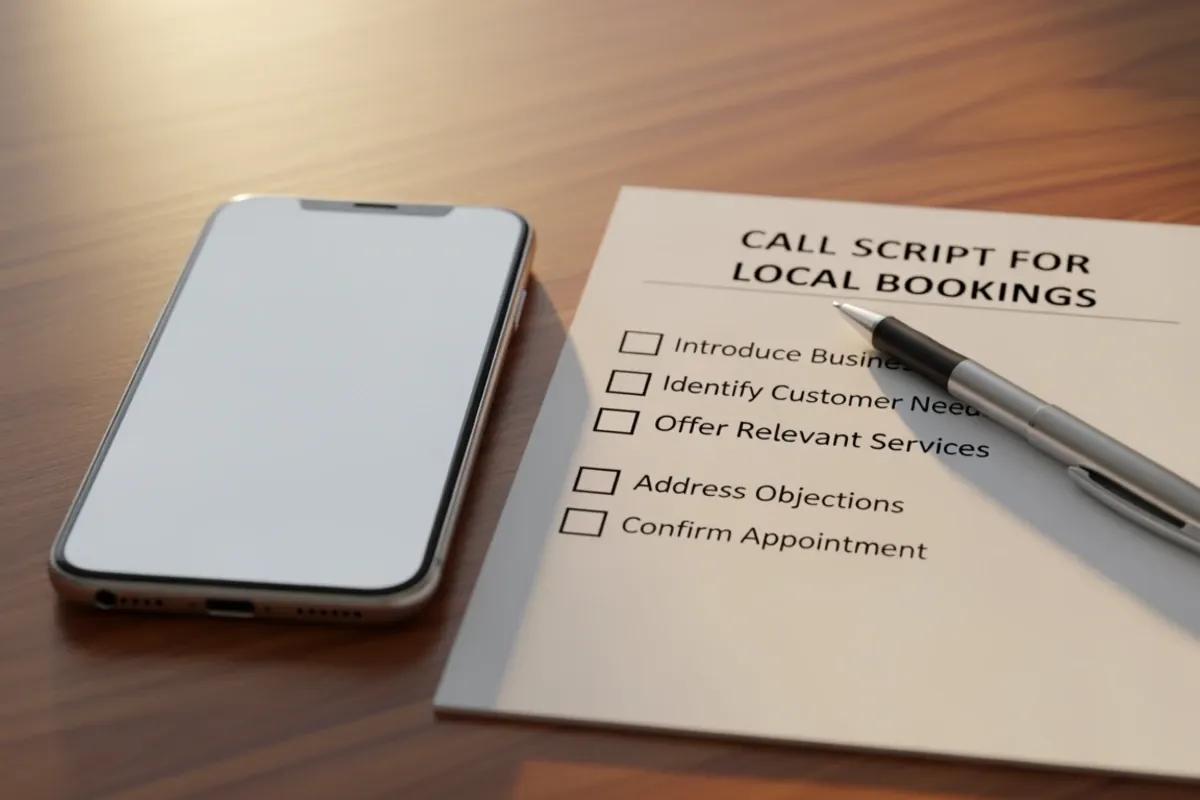
That’s why call scripts matter. Not stiff, robotic scripts. Those usually sound awful. I mean practical call frameworks that help your team ask the right questions, set expectations clearly, and move people toward a next step.
AI can help here too, though maybe not in the flashy way people usually talk about AI marketing or content creation. For many local teams, one of the most useful small business tools is a better script and a better process around it.
Why the phone still wins in local services
People pick up the phone when they want speed, reassurance, or both.
If a pipe is leaking, a furnace dies in winter, or a tenant is locked out, nobody wants a slow email thread. Even for less urgent services, a call gives customers something they can’t get from a website alone: a feel for whether they trust you.
That trust gets shaped fast. The first 30 seconds matter more than most teams admit.
If the person answering sounds rushed, confused, or vague, the caller starts shopping around. If they get voicemail and no call back, the lead may be gone before lunch. And if the quote feels squishy, like “it depends” with no explanation, people assume the final bill will get worse.
Most common failure points are painfully ordinary:
- missed calls during busy hours
- long hold times
- no clear next step
- quotes given too early with too little context
- no follow-up after an unbooked call
Speed-to-lead matters here. In many local categories, the first responsive company has a real edge. That doesn’t mean you should rush and say anything. It means your process should make it easy to respond clearly, quickly, and consistently.
What a booking script actually needs to do
A good script is less about wording and more about structure.
The goal is simple: help the caller feel heard, gather enough detail to guide them well, and secure a commitment to the next step.
Most solid scripts have three parts.
1. Greeting and trust cues
The opening should sound calm and competent. You want to answer the unspoken question in the caller’s head: “Did I reach someone who can help me?”
A useful opening is short:
“Thanks for calling. This is Maya. How can I help today?”
That’s it. No need for a speech. What matters is tone, pace, and confidence.
Trust cues come next. If the caller sounds stressed, acknowledge it.
“I’m sorry you’re dealing with that.” “Got it, that sounds frustrating.” “We handle that often. Let me ask a couple quick questions so I can point you in the right direction.”
Those lines work because they reduce uncertainty without promising too much.
2. Qualification and discovery
This is where weak calls usually fall apart. Teams either interrogate the caller or skip discovery and throw out a number.
You need enough information to understand the job, the urgency, and whether it’s a fit.
Useful questions often include:
- What’s happening right now?
- When did it start?
- Is this an emergency or something that can wait?
- What’s the service address?
- Is this residential or commercial?
- Has anyone already looked at it?
- Is there safe and clear access to the area?
The point is not to ask every question in the same order every time. The point is to get the details that shape scheduling and pricing.
3. Problem framing and next-step commitment
Once you know enough, summarize what you heard. This is one of the easiest ways to build trust.
“So from what you’ve told me, the upstairs unit is blowing air but not cooling, it started this morning, and you’d like someone out today if possible.”
That summary does two things. It shows you listened, and it gives the caller a chance to correct anything.
Then move to the next step:
“The best next step is a diagnostic visit so the technician can confirm the cause and give you exact options. We have an opening between 2 and 4 today. Would you like me to reserve that?”
Notice what’s happening there. You’re not ending with “What do you want to do?” which invites drift. You’re offering a clear path.
A simple base script you can adapt
Here’s a plain-language framework that works across many service categories:
“Thanks for calling [business name], this is [name]. How can I help?”
Caller explains the issue.
“I can help with that. Let me ask a few quick questions so I can give you the right next step.”
Ask discovery questions.
“Thanks, that helps. Based on what you described, the next step is [inspection / estimate visit / consultation / appointment]. For that, we [explain fee, range, or process clearly]. We have [time option] or [time option]. Which works better for you?”
If they hesitate:
“I understand. What would help you feel comfortable moving forward?”
That last question is underrated. It gets to the real objection faster than a hard sell ever will.
The script should change by industry
A script for a massage appointment should not sound like a script for a gas leak. That seems obvious, yet lots of teams use the same basic intake style for every lead.
Trades: plumbing, electrical, HVAC
Calls in trades usually revolve around urgency, safety, and access.
You need to learn:
- Is there an immediate safety issue?
- Is the system fully down or partly working?
- Who will be on site?
- Can a technician access the area?
For example, with electrical issues, safety language matters:
“If you smell burning or see sparking, please don’t touch the panel. If it feels unsafe, contact emergency services first. Once you’re safe, we can help with the next step.”
That builds trust because it puts the customer before the booking.
For plumbing, customers often want a price before you can reasonably give one. A better reply is:
“I can give you a typical range once I know a bit more, but with plumbing the cause matters a lot. A clogged line, a broken fitting, and a main issue can sound similar over the phone and end up being very different jobs.”
That sounds real because it is.
Wellness, spas, and personal care
These calls need more sensitivity and more preference-based questions.
You may need to ask about goals, comfort level, scheduling preferences, contraindications, or previous experiences. The tone should feel welcoming without drifting into vague reassurance.
For example:
“What are you hoping to get out of this appointment?” “Do you have any injuries, sensitivities, or health conditions we should note before booking?” “Do you prefer a quieter session, firmer pressure, or something more restorative?”
People often book when they feel understood, not when they hear the longest service menu.
Commercial vs. residential
Commercial calls often involve different decision paths. The person calling may not be the final decision-maker. They may care about documentation, timing around business hours, recurring service, or insurance requirements.
Residential callers usually care more about speed, price clarity, and whether someone seems trustworthy enough to enter their home.
So your script should reflect that difference.
For a commercial lead:
“Is this for a one-time issue or ongoing service?” “Do you need a certificate of insurance or service documentation?” “Who approves the work once the estimate is provided?”
For a residential lead:
“Is someone over 18 available during the appointment window?” “Do we need any gate code, parking details, or pet notes before arrival?”
Small detail, big difference.
Pricing and estimates without boxing yourself in
This is where many bookings die.
Customers want numbers. That’s fair. But local service businesses get into trouble when they give firm quotes too early, especially before seeing the job.
The fix is not to dodge the question. It’s to answer it honestly and with context.
Give process before price
Try this:
“I can explain how pricing works. We charge a diagnostic fee of $X for the visit. Once the technician sees the issue, they’ll give you exact options before any repair starts.”
That’s far better than saying, “We can’t tell you anything.”
Use ranges carefully
Ranges help when they’re grounded in real job patterns.
“For that kind of repair, we usually see totals anywhere from $150 to $450, depending on the cause and the parts involved. We’d need to inspect it to narrow that down.”
That works because it gives the caller something useful without pretending certainty.
When someone asks, “Can you beat this price?”
This question is rarely just about price. It usually means one of three things:
- they’re nervous about overpaying
- they don’t understand the difference in scope
- they’re collecting numbers and not ready yet
A calm answer is better than a defensive one:
“I can’t speak to what another company included, but I can explain our process and what the visit covers. If you have their quote, we can also help you compare scope so you’re looking at the same work.”
That keeps you out of a race to the bottom. Good. Those races usually end badly.
Objection handling that sounds human
Objection scripts should feel like conversation, not a debate club.
“I’ll call back”
A lot of callers say this when they feel uncertain, not when they truly plan to return.
Try:
“No problem. Before you go, would it help if I texted you the appointment options and pricing process so you have it in writing?”
Now you’ve kept the thread alive.
“That’s too expensive”
Don’t rush to discount. First understand what they mean.
“I get it. Is it the visit fee, the repair range, or the overall timing that feels off?”
That question matters. People often say “expensive” when they really mean “I don’t know what I’m paying for.”
Then respond based on the answer:
“The visit fee covers the technician’s time to diagnose the issue properly, and you’ll get exact options before deciding on any repair.”
“I’m comparing options”
Fair enough. Most people do.
A good response:
“That makes sense. When you compare, I’d check three things: what’s included, how soon they can come, and whether the quoted price is a real total or just a starting number.”
That helps the customer make a better decision, even if they don’t choose you. Ironically, that often makes them trust you more.
“Do you charge travel fees?” or “Why is there an availability gap?”
These are logistics objections. Treat them plainly.
For travel fees:
“Yes, for addresses outside our standard area there’s an added fee of $X. I’d rather tell you upfront than surprise you later.”
For schedule gaps:
“Our first opening is tomorrow morning. If anything opens today, I can put you on the priority callback list.”
Simple. Clear. No drama.
Follow-up is where a lot of revenue hides
Some of the easiest wins come from leads that did not book on the first call.
People get distracted. They compare options. They mean to call back and don’t. A same-day follow-up can rescue a surprising number of these leads if it sounds helpful rather than pushy.
Same-day follow-up for unbooked quotes
A call or text can be short:
“Hi Sam, this is Lena from [business name]. Just checking in on the quote you requested for the water heater issue. We still have availability tomorrow if you’d like to reserve a time.”
That’s enough.
Reminder and confirmation messages
These reduce no-shows and “I forgot” cancellations.
A good confirmation message includes the date, time window, address, and any prep steps.
“Confirmed for Tuesday, 10 to 12. Please make sure someone 18+ is available and the area near the unit is accessible.”
No-show recovery
No-shows are annoying, but the follow-up should stay professional.
“We missed you at today’s appointment. If you still need help, reply here and we can get you rescheduled.”
You’re giving them an easy way back in.
Using AI to build better scripts, without getting weird about it
AI is useful here, but it should support the team, not replace judgment.
One practical use is creating scenario-based script variants. You can prompt an AI tool to generate versions of the same call flow for after-hours emergencies, price shoppers, repeat customers, commercial property managers, or nervous first-time callers. That’s a much better use case than asking AI to write one “perfect” script for everyone.
AI can also help with role-play prompts for training:
- angry customer with an urgent plumbing issue
- cautious caller comparing three HVAC quotes
- spa client with medical contraindications
- office manager requesting recurring service documentation
That kind of practice is where teams improve fast.
If you already use AI marketing systems or AI for content creation, this is a nice reminder that the phone deserves the same attention as your website copy and ads. Sometimes a better intake script lifts conversions more than another month of ad spend.
But a few guardrails matter.
Keep privacy and compliance in view
If calls are recorded, customers may need notice depending on your location. If AI is summarizing calls, make sure private information is handled carefully. And if you’re in health-related services, be extra cautious with sensitive data.
Also, don’t let AI write claims your team can’t support. A script that promises same-day service “every time” will create a mess if your calendar says otherwise.
Measure what actually improves bookings
The best script is not the prettiest one. It’s the one that books good-fit jobs.
Track a few things consistently:
- booking rate by lead source
- percentage of calls answered live
- unbooked quote follow-up rate
- no-show rate
- close rate by service type
- common objections by category
Call outcome tracking is especially helpful. If you tag outcomes like “booked,” “quoted not booked,” “price objection,” “out of area,” or “no answer,” patterns show up quickly.
Maybe your website leads convert poorly because they call after hours and hit voicemail. Maybe one service category has a high quote rate but low close rate because your pricing explanation is weak. Maybe commercial callers need a different script entirely.
That’s the real work: listen, track, refine, repeat.
A script is never finished. It should keep getting better as you hear real calls and learn what helps people say yes.
The takeaway
Phone calls still carry a lot of weight in local services because trust is hard to fake in real time.
A good script does not pressure people. It reduces confusion. It helps your team ask smarter questions, explain pricing more clearly, and guide callers to a specific next step. Done well, that turns more quotes into bookings without turning your staff into robots.
And if you use AI, use it like a coach. Build variations. Practice hard scenarios. Review outcomes. Tighten what’s muddy.
That’s usually what moves the needle. Not magic. Just better conversations.

